 Woodstove Edition
Coffee, Tea or Plain Water: Choosing the Morning Cup for Lion's Mane Drops
The seller says its lion's mane liquid can go into your favorite drink or be taken alone. From a woodstove kitchen, I weighed what each of my three morning cups brings with it.

This is a paid advertisement. Sponsored by MRO MaryRuth, LLC.

Clyde Merrick is the pen name of this desk.
Everything on this page about the bottle comes from the seller's own label, product page and posted policies, read on September 21, 2026.
The customers quoted further down are real, and their reviews are public on the seller's site.
The small photographs beside them are illustrations, not the reviewers.
The kettle goes on the woodstove at a quarter to six in our house, before the dog is up and before the radio.
By noon I have had three cups, and they have been the same three cups for most of my life.
The first is coffee, black, in a heavy white mug that has lost its handle glaze on one side.
The second is tea, in the lull of the late morning, when the stove has settled down and the room is warm.
The third is water, and it is the one I forget.
If I am honest, I drink it only when I fill the kettle and taste a mouthful to check it is cold.
A man's morning cups are about as fixed as anything in his life.
We change trucks, barbers and even churches more readily than we change what we drink at the kitchen table.
So when I read a sentence on a seller's page that said a product could go straight into my cup, I stopped and read it twice.
The product was a lion's mane mushroom liquid, the kind sold in a small glass bottle.
The sentence read: "Whether added to your favorite beverage or enjoyed on its own."
That is an invitation to put it in the coffee, and I have learned to read invitations slowly.
Because the cup is not empty when you add something to it.
Coffee brings its own chemistry, tea brings its own, and even a glass of water brings something a man over sixty is often short of.
Nothing goes into an empty cup.
This page is the long version of a short question.
If I am going to take a milliliter of anything each morning, which of my three cups should carry it?
To answer that I have to take each cup seriously on its own terms first.
Then I will set the bottle on the table, read its label line by line, and come back to the cups with the numbers in hand.
I will also tell you what the research on this mushroom found, and where it stops.
And I will tell you what the maker itself says to men past sixty-five, because it says something, and it matters here.
Two things before we start.
This is a paid page, sponsored by the company that sells the bottle, and the byline above says so in plain words.
And if you know you react to mushrooms of any kind, this is where the page ends for you.
Three Cups Before Noon in a House With a Woodstove
A woodstove sets the pace of a morning in a way a thermostat never does.
You wake the fire, you wait for it, and the kettle sits on top because that is the warmest place in the house to keep it.
That is why the three cups in our house all come from the same kettle.
Coffee from the percolator that sits beside it, tea from the kettle itself, and the water from the tap that fills it.
The coffee is twelve ounces, near enough, because that is what the heavy mug holds when you fill it to where a man can carry it without spilling.
The tea is a smaller cup, eight ounces, from a pot that has been in the family since before I married.
The water, when I remember it, is a plain tumbler from the drying rack.
I have never measured it, which tells you what I think of it.
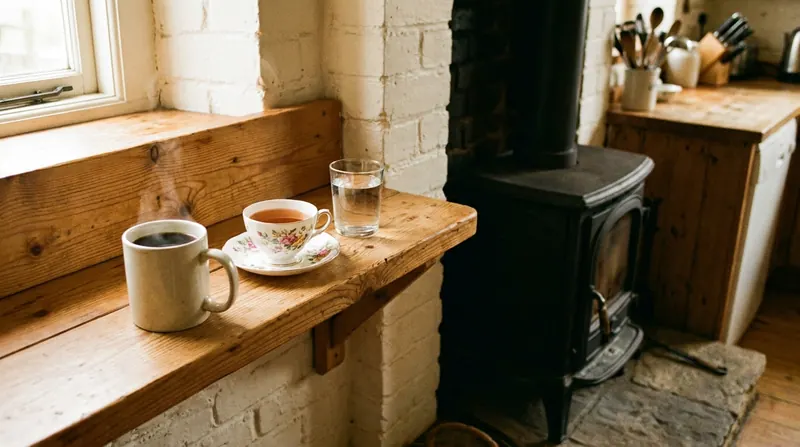
I suspect your mornings have the same shape, even if your stove runs on gas.
One cup to get going, one to keep going, and one you know you should drink more of.
Each of those cups is already doing something before anything is added to it.
That is the whole point of this first half of the page.
A milliliter of liquid stirred into twelve ounces of coffee is a small guest in a large and busy room.
It is worth knowing who else is in the room before you send it in.
So I sat down at the kitchen table with the three cups and the plain facts about each of them.
Most of those facts come from federal agencies that publish them for anyone who asks.
None of what follows is special knowledge, and none of it is exotic.
It is the sort of thing a man could learn in an afternoon, if he ever had a reason to look.
The seller's sentence gave me the reason.
Here is what I found out about my own cups, one at a time, starting with the one I love most.
The First Cup: Coffee, and the Number Worth Knowing
Coffee is the cup that carries the most freight, and the freight is caffeine.
The Food and Drug Administration puts a twelve-ounce cup of brewed coffee at somewhere between 113 and 247 milligrams of it. [1]
That is a wide range, and the width is the first lesson.
The same mug, filled from a different pot or a different bean, can hold twice as much as it did yesterday.
The agency also gives a daily figure: about 400 milligrams is an amount not generally associated with negative effects in most healthy adults. [1]
By its own arithmetic, that is two to three of those twelve-ounce cups.
The food safety agency in Europe arrived at a similar place on its own.
It found that single doses up to 200 milligrams and a day's total up to 400 do not raise safety concerns for healthy adults. [2]
It also says what caffeine does in moderate amounts: it increases alertness. [2]
That sentence is the reason coffee is a poor cup for judging anything else you add to it.
Think about it the way you would think about a new tool in the shop.
If you try the new saw on the same day you sharpen the old chisels, you will never know which one made the cut cleaner.
A cup of coffee is already a small, reliable lift for a lot of men in the morning.
Anything you stir into it will ride along on that lift, and you will have no way of telling the two apart.
That does not make coffee a bad cup.
It makes it a noisy one, and a man who wants to know what a new habit is doing wants a quiet room.
There is a second thing to know about coffee, and the agency spells it out.
Too much caffeine can bring a faster heartbeat, jitters, an upset stomach, a headache, and trouble getting to bed at night. [1]
The same page says some people are more sensitive to caffeine than others, including people who take certain things every day. [1]
Its advice is to talk with a health care provider if you do.
That is not a reason to give up coffee, and I have no intention of giving up mine.
It is a reason to keep coffee's own ledger separate from anything new you start.
If I stirred a new liquid into my mug and felt a little jumpy by nine, I would not know whom to blame.
The coffee would be the obvious suspect, but it would get off on a technicality, because the other liquid was in the cup too.
The first cup already does what the labels on the supplement shelf like to promise, and it does it every morning.
One last coffee point, and it is a practical one.
Many of us take our coffee with sugar or a sweet creamer, and the liquid we are coming to later is sweet in its own right.
A man who drinks his coffee black would taste the difference at once.
A man who takes it sweet might not taste it at all, and that is not the same as it not being there.
The Second Cup: Tea From the Kettle
Tea sounds like the gentler cousin, and in most kitchens it is treated that way.
But green, black and oolong teas all come from the same plant, and a federal fact sheet on green tea notes that it contains caffeine. [3]
That surprised a couple of the men at the feed store when I mentioned it.
They had switched to tea in the afternoon precisely to get away from the coffee.
The fact sheet does not put a number on the caffeine in a cup, and I will not invent one. [3]
What it tells you is enough: a cup of tea from that plant is not a caffeine-free cup, whatever color it is.
What many of us call herbal tea is a different thing altogether, steeped from other plants.
Those cups carry their own ingredients, and each one would need its own page.
So the second cup is quieter than coffee, but it is not silent.
It still carries some of the same freight, and the kettle does not know which kind of tea you poured it over.
Tea brings one more thing coffee does not, and that is heat held for a long time.
A pot of tea on the back of a woodstove stays hot for an hour, and a cup poured from it stays hot longer than you would think.
I mention heat because it turns out to be one of the questions the bottle's label does not answer.
I will come back to it when the bottle is on the table.
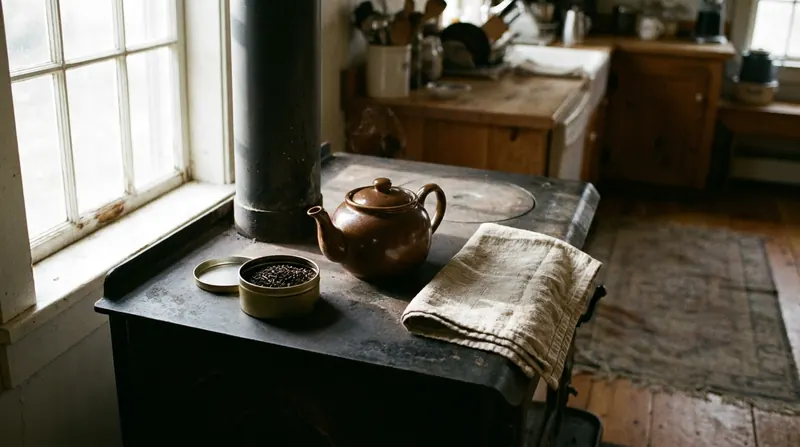
For now, the second cup goes into the ledger this way.
It is smaller than the coffee, it is milder than the coffee, and it is still not a blank slate.
If you drink tea, you know your tea better than any fact sheet does.
The point is only that it has a voice of its own, and anything you add to it will have to speak over that voice.
The Third Cup: Plain Water, the One Men Skip
The third cup is the one I have neglected for fifty years, and I do not think I am alone.
Water has no taste to look forward to and no lift to wake you up, so it slides to the bottom of the list.
Researchers in Berlin measured it properly in 1,111 adults aged sixty to eighty-nine, using a blood test rather than asking people how much they drank. [4]
About a third of them turned out to be short of water.
Over the years that followed, the ones who were short of water showed a steeper drop on a test of how quickly the mind processes information. [4]
That study watched people over time, so it can show that the two went together, not that one caused the other.
Still, I read that paragraph twice, sitting beside a woodstove that dries the air in the kitchen every winter morning.
A man who drinks one tumbler before noon is not making a choice about water; he is simply forgetting it.
Water has one more quality that matters for this page, and it is the plainest one.
It brings nothing to the cup except itself.
There is no caffeine in it, no sugar, no plant compounds and no heat unless you add heat.
If you want to know what a new liquid tastes like, and later what it does or does not do, water is the only cup that leaves the question clean.
I did not expect the dullest cup on the shelf to be the one that answered my question.
But that is where the ledger was leaning, and I had not even opened the bottle yet.
A Milliliter Measured Against the Cups on My Shelf
Before any bottle comes into it, it helps to know how small a milliliter is next to the cups a man actually drinks from.
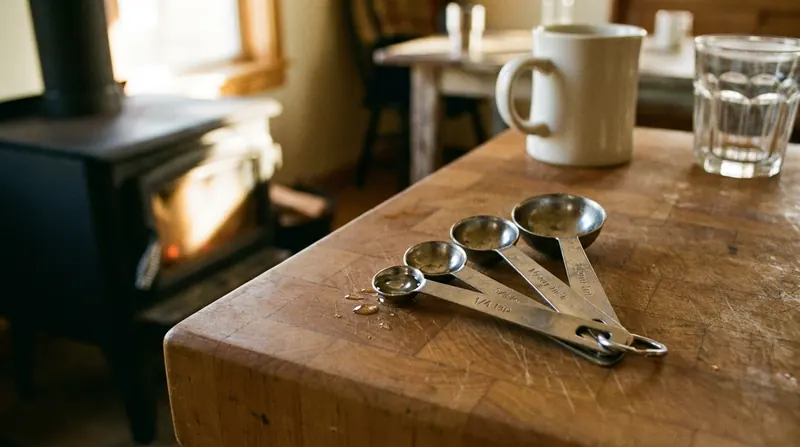
I got out the measuring spoons from the drawer by the stove, the ones my wife used for forty years of biscuits.
A level teaspoon holds five milliliters, and a level tablespoon holds fifteen.
So a milliliter is a fifth of a teaspoon, a smaller amount than most of us have ever measured on purpose.
Now the cups.
A twelve-ounce mug holds about 355 milliliters, an eight-ounce teacup about 237, and my tumbler, when I filled it from a measuring jug, about the same as the teacup.
Put a milliliter into each of them and you get three very different pictures.
In the mug it is one part in about 355, in the teacup one part in about 237, and in the tumbler the same.
The numbers are close, and the cups are not.
What changes from one to the next is not how much the milliliter is diluted, but what else is waiting in the water.
That sounds like a small point, and it is the one this whole page turns on.
A milliliter in a big mug is not weaker than a milliliter in a small glass; it is simply keeping different company.
The mug adds caffeine and heat, the teacup adds a little caffeine and a long hold of heat, and the tumbler adds nothing.
If you only remember one line from this section, remember that the size of the cup matters far less than what is already in it.
There is a second thing the measuring spoons taught me, and it is about accuracy.
A liquid measured by eye, splashed from a bottle into a cup, is never the same amount two mornings running.
Anything meant to be taken by the milliliter needs a way to measure the milliliter.
I will come back to how this bottle does that, because it is the first practical question once it is on the table.
For now it is enough to know the scale of the thing.
We are talking about a fifth of a teaspoon, stirred into a cup that holds more than three hundred times as much.
That is not a lot of liquid, and it will not change the taste of a large mug very much.
It will change the taste of a plain glass of water, and later on that turns out to be useful rather than a drawback.
Before I set the bottle down, one more stop, because the bottle is only the last step of a longer story.
It starts on a log in the woods.
A Mushroom That Grows on the Wood We Burn
Lion's mane is an edible mushroom with long white spines that hang down like an icicle fringe.
It grows on older beech and oak trees in the forests of the Northern Hemisphere, and it is eaten as food in East Asia and, more and more, here at home.
Beech and oak are what a lot of us split for the stove.
It pleased me to learn that the mushroom in question has been living on the same wood that heats my kitchen.
People who cook it fresh compare the texture to crab or lobster.
They tear it into pieces, brown it in a skillet with butter, and eat it the way you would eat any other good mushroom.

The part you would eat, the white shaggy clump, is called the fruiting body.
That distinction matters on labels, because some mushroom products are grown on grain and weigh the grain in with the mushroom.
In Japan the mushroom is called yamabushitake, and it has a long history there and in China as a food.
None of that history tells you what a spoonful of extract will do, and I will not pretend it does.
But it does tell you what kind of thing you are dealing with.
This is a food mushroom first, and everything else about it comes after that.
Which brings me back to the seller's sentence, and to the small glass bottle it was written about.
It is time to put it on the table next to the three cups.
The Small Bottle That Asked to Share My Cup
The bottle is MaryRuth's Organic Lion's Mane Liquid Drops, sold by MRO MaryRuth, LLC, a family company in Los Angeles.
It is a one-ounce amber glass bottle with a black cap, and inside the cap there is a glass tube with a rubber bulb for measuring.
I had seen the name before, on a shelf in my daughter's kitchen, among the things she buys for her own household.
I had never looked closely until the sentence about the favorite beverage caught my eye.
What follows is everything the label and the seller's page say, and what I make of it for a man with three cups on his shelf.
I have left nothing out that bears on the cup, and I have added nothing the label does not say.
What Is Actually in the Milliliter You Stir In
The Supplement Facts panel has one active line, and it is short enough to copy out in full.
Organic lion's mane, Hericium erinaceus, fruiting body extract: 1.18 grams per one-milliliter serving, which the label also writes as 1,180 milligrams.
Below it, the other ingredients: organic vegetable glycerin and purified water.
That is the whole bottle, and I like a label I can read in one breath.
The front of the bottle carries the seller's own badges: organic, made without alcohol, no gluten, non-GMO and vegan.
The organic line is backed by the federal organic seal on the label, and the rest are the seller's own descriptions of what is not in it.
So one milliliter holds lion's mane from the part of the mushroom you would eat, in a sweet base, with nothing else.
That is a clean answer to the first question anyone asks about a new liquid.
The second question is harder, and the label cannot answer it.
What does 1,180 milligrams of "extract" mean in terms of actual mushroom?
The weight on the panel is the weight of the liquid extract, glycerin and water included in the process.
The label prints no ratio of dried mushroom to extract, and no figure for any of the compounds people study in this mushroom.
That is common on liquid extracts, and I do not count it as a mark against this one in particular.
But it means you cannot set 1,180 milligrams beside the grams of dried mushroom used in a study and call them the same thing.
I will come back to that when we get to the research, because it is the heart of the matter.
For the cup question, what matters is simpler: you are adding one milliliter of a sweet, dark liquid to whatever you drink.
As the measuring spoons showed, that is a fifth of a teaspoon.
In a twelve-ounce mug of coffee it is a thin thread of liquid lost in a large cup; in a plain glass it is the only thing there besides the water.
The label's directions are short, and they matter for the cup.
The seller's page reads: "Shake gently before use. Adults 14+, take up to 1 mL 1 to 3 times a day," and then leaves room for the advice of a healthcare professional.
It adds one more line: "Do not exceed the recommended dose."
And separately it says the liquid can be taken on its own or added to your favorite beverage, which is where we came in.
Notice what the directions leave to you.
They set a ceiling, one milliliter, up to three times a day, and they set nothing below it.
They do not say morning or evening, with food or without, hot or cold, coffee or water.
The cup, in other words, is entirely your choice, and so is the hour.
There is one small matter of arithmetic I should get out of the way.
The panel says "Servings Per Container About 30," and the seller's description says "Each bottle comes with 60 servings."
Thirty one-milliliter servings is what an ounce holds, and that is the number I trust, because it is on the panel.
I will do the full count of days later, cup by cup, because the answer changes with how many times a day you take it.
Hot, Cold or Room Temperature: What the Label Does Not Say
Here is the question that sent me to the telephone, or would have if it were not before six in the morning.
If I stir this into a mug of coffee straight off the stove, does the heat matter?
The label does not say.
The seller's page does not say either, beyond the sentence about your favorite beverage.
I looked for a line about temperature and found none, and I am not going to make one up.
I cannot tell you whether a hot cup changes anything in a liquid extract, and no one on this page will pretend to.
What I can tell you is how I would handle a question the label leaves open.
There are two sensible ways, and neither requires you to take my word for anything.
The first is to ask the people who make it.
The seller publishes a telephone number, 310-955-1353, and an email address, wecare@maryruthorganics.com, and a question like this is exactly what they are for.
The second is to follow the label as closely as it can be followed.
"Enjoyed on its own" is the first option the seller gives, and a glass of plain water at room temperature is as close to "on its own" as a cup gets.
That is what I would do, and it is a choice about caution, not a claim about chemistry.
If the seller tells you a hot cup is fine, then a hot cup is fine, and you will have heard it from the people who know their own process.
There is also a middle road that costs nothing.
Pour the coffee, let it sit until it is the temperature you actually drink it at, and stir the milliliter in then.
A mug you can hold to your lips is a long way cooler than a kettle at the boil.
That is plain kitchen sense, and it does not require any knowledge of mushrooms.
Tea left on the back of a woodstove is the hottest cup in my house, and it stays that way.
If I were going to use tea at all, I would use a cup that had been poured and left to stand.
But I keep coming back to the glass of water.
Not because the hot cups are wrong, but because the water answers more questions at once.
Why Plain Water Is the Honest Cup
Let me put the three cups side by side again, now that the bottle is on the table.
Each has something to say about what a milliliter of lion's mane would be doing in it.
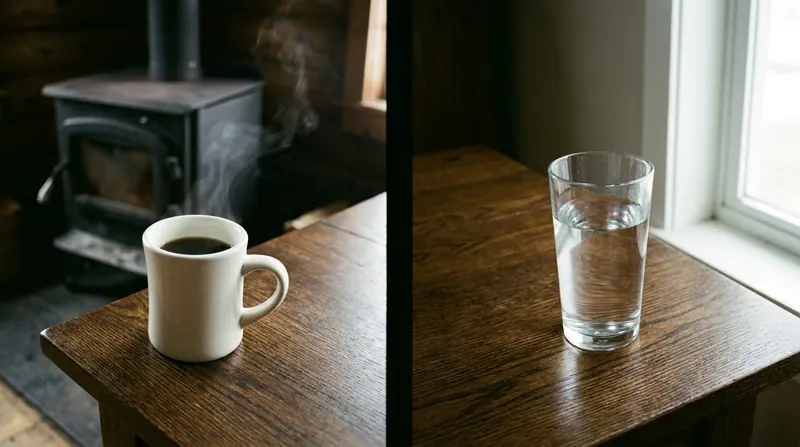
Coffee. It brings between 113 and 247 milligrams of caffeine to a twelve-ounce mug, and caffeine raises alertness on its own. [1] [2]
Anything you notice after a cup of coffee, you will not be able to credit to anything else in the cup.
Tea. If it is green, black or oolong, it comes from a plant that carries caffeine, in amounts the fact sheet does not state. [3]
It is quieter than coffee, but the same problem applies at a lower volume.
Water. It brings no caffeine, no sugar, no heat and no taste of its own.
It is the only cup in the house where the milliliter is the only new thing.
There is another reason, and it is about taste.
The base of this liquid is vegetable glycerin, which is sweet and syrupy, and in water you will taste it exactly as it is.
That is useful, because some people like the taste and some do not, and the reviews say both.
Better to find out in a plain glass than to blame the coffee for tasting odd on a Tuesday.
And there is a reason about counting.
A man who takes one milliliter in a glass of water knows he took one milliliter, and nothing else, at that hour.
If you ever want to tell whether a habit is worth keeping, you need to know exactly what the habit was.
Water gives you that, and neither of the hot cups can.
None of this means you have to give up the other cups, or drink this in water forever.
It means that for the first month, while you are finding out whether you like it, the water glass keeps the books straight.
Coffee for the morning, water for the milliliter.
That is my answer to the headline, and I will stand by it for the rest of the page.
If you would rather use your coffee after all, the label allows it, and you will have read this far knowing what you are trading away.
The Maker's Own Line for Men Past Sixty-Five
There is one sentence on the seller's page that every man reading this should know about.
It is the maker's, not mine, and it sits right under the standard notice that the claims have not been evaluated by the Food and Drug Administration.
In plain words, it asks children under twelve, adults over sixty-five, and anyone pregnant or nursing to consult a healthcare professional before use.
It does not give a reason, and I will not supply one on the maker's behalf.
I take a sentence like that at face value.
A company that writes it about its own product is telling you where its own caution starts, and sixty-five is well behind most of the men who read this paper.
So the first cup this bottle should go into is not coffee, tea or water.
It is a conversation at the pharmacy counter, with the bottle in your hand and a list of everything you take each day in your pocket.
Pharmacists answer this kind of question every day, at no charge, and they have the list of what you already take on their screen.
Ask them in plain words: "Is a milliliter of lion's mane liquid, once to three times a day, all right with what I take?"
There is one clear reason not to take it that the label and the plain facts give you.
If you react to mushrooms, as some people do, this bottle is a mushroom, and a few people in one study reported stomach discomfort, nausea or a rash.
If the pharmacist says to wait, wait, and let the bottle sit on the shelf until you have an answer you trust.
That is not a formality.
It is the same thing I would do before adding anything new to a morning that has worked well enough for decades.
Glycerin in the Cup: The Question of Sweetness
The base of this liquid deserves a section of its own, because it is what you will notice first.
Vegetable glycerin is a clear, sweet, syrupy liquid obtained from plant oils.
In an extract made without alcohol, glycerin does the job alcohol would otherwise do.
It draws out and holds the mushroom's compounds, and it keeps the bottle from spoiling on the shelf.
It is a common food ingredient, and large amounts of it can loosen the stomach.
A milliliter is not a large amount, but it is worth knowing what the base is before it goes in your cup.
The sweetness is the thing people either like or do not.
In black coffee it will show; in coffee with sugar it will disappear; in water it will taste exactly like what it is.
Two of the reviews on the seller's page say exactly this, from opposite sides.
Here they are, word for word, along with two more that bear on the glass and the stomach.

This product makes a difference. I give it to my entire family. The taste is sweet and goes in smoothies unnoticed.

Too sweet for me, does it come in capsules instead
Rae's is the review for a man who wants to hide the taste in a drink, and she names the drink: a smoothie.
Cindy's is the review for a man who takes his coffee black and does not want anything sweet anywhere near it.
I kept Cindy's three stars on purpose.
A review that says "too sweet for me" is more useful to a coffee drinker than ten that say "love it."
If you are a black-coffee man, take her at her word and use the water glass.
If you already sweeten everything, you will likely never notice it, which is Rae's point.

Easy to digest
Gwendolyn's review is three words long, and I kept it because it answers a question men ask about anything new: how does it sit?
Three words from one buyer is not a study, and I do not offer it as one.
A Glass Bottle and a Stone Hearth
The fourth review is not about the liquid at all.
It is about the bottle, and anyone who keeps things on a stone hearth or a tile counter should read it.

I had this supplement for one week. Typically I would love glass bottles, but at the end of the week I reached for the bottle and it slipped from my hands. The bottle shattered so I never got to enjoy the benefits of the supplement.
The bottle is amber glass, and glass is the right choice for a liquid like this, because it keeps light out and does not flavor what is inside.
But glass meets stone the same way every time.
My hearth ledge is slate, and it is the most convenient place in the kitchen to set a cup down.
It is also the worst place in the kitchen to set down something small and slippery with a glycerin film on its neck.
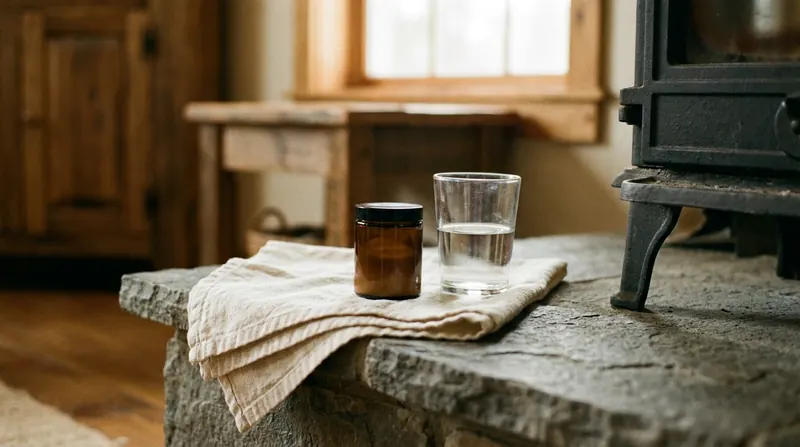
So the bottle in our house would live on a folded towel, not on the bare stone.
And it would go back on the shelf with its cap tight after every use, before the glass tube has a chance to drip.
It is a small thing, but a broken ounce is a lost month.
The seller's own reviews include one from a buyer whose bottle broke in the post, so glass has two chances to go wrong, and one of them is in your own kitchen.
Keep it away from the stove's own heat too.
A shelf near a woodstove can get warmer than you would think, and a label that says nothing about temperature is not asking to be kept warm.
The Study Everyone Quotes, and What Was in Its Cup
Now to the research, because every page about lion's mane leans on the same small study, and it deserves a careful reading.
It was done in Japan, and it was published in 2019.
Thirty-one healthy adults over fifty took either a lion's mane preparation or a look-alike placebo every day for twelve weeks. [5]
The preparation was made from the dried fruiting body, and the daily amount was 3.2 grams. [5]
At the end, the lion's mane group scored higher than the placebo group on a standard short test of mental status. [5]
A second test in the same study, of visual memory, did not change.
That is a real finding, from a real trial with a placebo, and I do not wave it away.
But it is thirty-one people, one country, one short test, and grams of dried mushroom, not milliliters of liquid.
Here is where the cup question and the research question meet.
The trial measured grams of dry mushroom, and the bottle measures milligrams of a liquid made with glycerin and water.
Three milliliters a day, the label's ceiling, would be 3,540 milligrams of liquid extract.
That looks larger than 3.2 grams on paper, and it is not the same thing at all, because the liquid's weight includes the base it was made in.
I would like to tell you how much dried mushroom went into one milliliter.
The label does not say, and without that figure no honest writer can match this bottle to that trial.
There is a second, smaller study that turns up on these pages, and it is worth a sentence or two.
In forty-one healthy adults aged eighteen to forty-five, a single 1.8-gram dose of lion's mane was followed by faster performance on a word-and-color attention test an hour later. [6]
Over twenty-eight days of the same supplement, the same study found only a trend on a questionnaire that did not reach significance. [6]
Those volunteers were young, the dose was measured in grams, and the authors themselves call it a pilot.
So the honest summary of the research fits in two lines.
One small trial in adults over fifty found a higher score on one short test with grams of dried mushroom, and nothing yet connects that amount to a milliliter of this liquid.
That does not make the bottle worthless, and it does not make it a sure thing.
It makes it a food mushroom in a sweet base, with a label that tells you what is in it and not how it compares.
I would rather tell you that plainly than borrow a trial's result for a bottle the trial never tested.
And it is one more reason for the water glass: if you are going to find out anything, find it out cleanly.
How Long One Ounce Lasts, Cup by Cup
Now the arithmetic, because a man should know what a habit costs before he starts it.
The bottle holds one fluid ounce, thirty milliliters, and the panel says about thirty servings of one milliliter.
At one milliliter a day, the bottle lasts about thirty days.
At two a day it lasts about fifteen, and at the label's ceiling of three a day it lasts about ten.
The seller's price on the day I read the page was $21.95 for the one-ounce bottle.
That works out to about $0.73 a day at one milliliter, $1.46 at two, and $2.20 at three.
One buyer's four-star review on the seller's page says the bottles "don't last a whole month" at the amount she took.
She is right, at more than one milliliter a day, and I would rather you heard it here than found it out on day eleven.
This is where the cup question touches your wallet.
If you take it in coffee, and you drink three mugs, you may be tempted to take it three times.
The number of cups you drink is not a reason to take the liquid more often.
The label sets a ceiling, not a target, and one milliliter once a day is inside it.
So my plan, if I were starting, would be the plainest one the label allows.
One milliliter, once a day, in a glass of water, for thirty days, which is one bottle and one month.
The seller sends orders within the US, and shipping comes at no charge on orders from $49 and up.
One $21.95 bottle does not reach that line on its own, so expect to pay shipping on a single bottle.
The seller also posts a thirty-day satisfaction policy with a refund.
Read its terms on the seller's page before you order, because the details of any refund are theirs to set, not mine.
What Costs Nothing at the Kitchen Table
Before anyone spends $21.95, there are things in the same kitchen that cost nothing at all.
They are worth a section, because a bottle is the smallest part of any morning.
The first is the third cup.
If a third of the older adults in that Berlin study were short of water, the cheapest habit in this whole article is a tumbler every time you fill the kettle. [4]
I have started doing exactly that, and it has added four glasses to my morning without any effort I would call effort.
The kettle gets filled anyway, and the tumbler sits on the drying rack right beside the tap.
The second is what sits beside the coffee.
In a Brazilian study that followed 10,775 adults for about eight years, those who ate more ultraprocessed food showed a faster drop in scores on tests of thinking than those who ate the least. [7]
That was an observational study, so it shows the two went together and not that one caused the other.
But a man does not need a trial to know that the packaged pastry beside his mug is not doing him any favors.
The third is what goes on the plate at supper.
In a three-year trial of 604 older adults with normal thinking, a group eating a diet built on vegetables, berries, beans, nuts, fish and olive oil improved its scores on tests of thinking. [8]
So did the comparison group, which ate its usual diet with a modest cut in calories, and the difference between the two groups was not significant. [8]
I tell you that because it is true, and because it means the sensible plate and the lighter plate both did about as well.
None of that is a reason to skip the bottle if you want to try it.
It is a reason to put the bottle in its proper place, which is behind the water, the plate and the pastry you did not eat.
A tumbler at every kettle, a real supper, and fewer things from a wrapper: that is the part of the morning that costs nothing.
There is one more habit that costs nothing, and it is the one the woodstove gives every man who owns one.
Splitting and carrying wood keeps you moving whether you meant to or not, and I have never met a stove owner who sat still all winter.
One ounce, thirty mornings, one glass of water
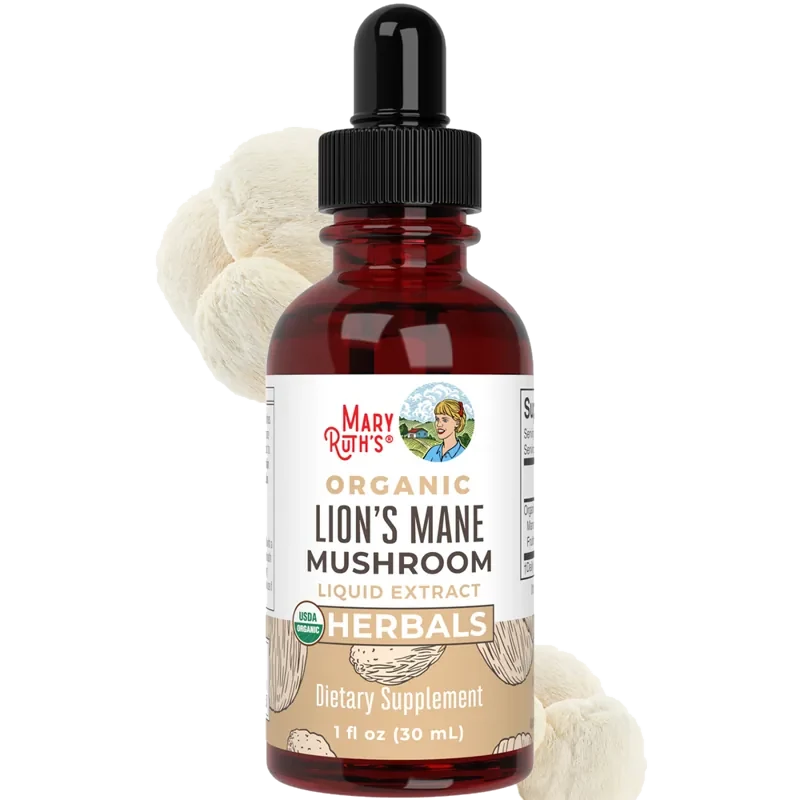
A measured milliliter of organic lion's mane extract in glycerin and water, from a Los Angeles family company, with the dose printed on the glass.
SEE THE LION'S MANE LIQUID AT MARYRUTH'SSold by MRO MaryRuth, LLC, Los Angeles · 1 fl oz (30 mL), about 30 servings of 1 mL · up to 1 mL, 1 to 3 times a day, for adults · 30-day satisfaction policy on the seller's site · shipping at no charge from $49 in the US
Who This Bottle Suits, and Who Should Pass
Here is the plain sorting, as best I can make it from the label, the reviews and the research.
Read both lists; if you land on the second, the first does not matter.
It may suit you if:
- You would rather not swallow anything and prefer a liquid you can measure.
- You are content with one milliliter a day in a glass of water, and a bottle a month.
- You like, or do not mind, a sweet taste, or you already sweeten what you drink.
- You want a food mushroom from the part you would eat, in a base made without alcohol.
- You accept that the research gives no promise about memory, and you are buying a habit, not a result.
It is not for you if:
- You react to mushrooms. This bottle is a mushroom.
- You are over sixty-five and have not asked your pharmacist yet. The maker asks you to check first, and so do I.
- You take your coffee black, hate sweetness, and will only take it in coffee. Cindy's three stars were written for you.
- You want the bottle to do what one trial with grams of dried mushroom found. Nothing on the label connects the two amounts.
- You plan to take it three times a day because you drink three cups. The bottle will last ten days, and the label does not ask for it.
If you are on the first list, the next section is a plain month laid out.
If you are on the second, you have lost nothing but ten minutes, and you know more about your three cups than you did.
Thirty Mornings, Set Out Plainly
If I were starting tomorrow, this is how the month would go, step by step.
Nothing in it goes beyond what the label allows, and most of it is kitchen sense.
- Take the unopened bottle and your list of daily things to the pharmacist first, and ask the plain question.
- Keep the bottle on a folded towel on a shelf, not on the hearth stone and not near the stove's heat.
- Shake it gently, as the label asks, before each serving.
- Draw one milliliter with the glass tube, using the mark on the tube, and let it fall into a glass of plain water.
- Stir, drink the glass, and put the cap back on tight before the tube can drip.
- Take it at the same hour each day, and keep your coffee and tea exactly as they were.
- Drink a tumbler of water every time you fill the kettle, whether or not it is the milliliter's glass.
- At the end of thirty days, judge the habit by the taste, the stomach and the cost, and decide whether to buy a second bottle.
That is the whole plan, and it fits on the back of an envelope.
One bottle, one glass a day, one month, and the coffee left alone so you can tell the two apart.
If the taste suits you and the stomach is happy, you will know by the end of the month whether it earns a place on the shelf.
If it does not, the seller's thirty-day policy is there, on its own terms, and you will have spent one bottle finding out.
Questions that come up while the kettle heats
Can I put it in my coffee?
The seller says it can go into your favorite beverage, so yes. Coffee brings its own caffeine, though, and you will not be able to tell the two apart. [1]
Does hot coffee or tea change it?
The label does not say, and neither does the seller's page. Ask the seller at 310-955-1353, or use water at room temperature until you know.
Is this medicine?
No. It is a dietary supplement made from one mushroom in glycerin and water, and its label carries the standard notice that its claims have not been evaluated by the Food and Drug Administration.
I'm over 65. What should I do first?
The maker asks adults over sixty-five to consult a healthcare professional before use. Take the bottle and your list of daily things to the pharmacist.
How sweet is it?
Sweet enough that one buyer called it too sweet, and another said it disappears in a smoothie. The sweetness comes from vegetable glycerin.
Does it contain alcohol?
No. The base is organic vegetable glycerin and purified water, and the seller lists it as made without alcohol.
How long does one bottle last?
About thirty days at one milliliter a day, fifteen at two, and ten at three. Plan by the panel's "about 30," not the "60 servings" in the description.
Will it help my memory?
I cannot tell you that. One small trial with grams of dried mushroom found a higher score on one short test, and nothing on this label connects that amount to a milliliter. [5]
Who should not take it?
Anyone who reacts to mushrooms. And anyone over sixty-five who has not yet checked with a pharmacist or clinician.
Can I send it back?
The seller posts a thirty-day satisfaction policy with a refund. Read its terms on the seller's page before ordering.
The Whole Morning, Read Back Over One Cup
- The seller writes that its lion's mane liquid can be "added to your favorite beverage or enjoyed on its own," and the label sets no rule about which cup.
- A twelve-ounce mug of brewed coffee brings 113 to 247 milligrams of caffeine, and caffeine raises alertness on its own, so coffee is a noisy cup to judge anything by. [1] [2]
- Green, black and oolong teas come from one plant that carries caffeine, and a pot on the back of a woodstove is the hottest cup in the house. [3]
- About a third of adults over sixty in one large study were short of water, and water is the only cup where the milliliter is the only new thing. [4]
- One milliliter holds 1,180 milligrams of lion's mane fruiting body liquid extract in organic vegetable glycerin and purified water, made without alcohol.
- The label says nothing about temperature; ask the seller, or use water at room temperature.
- The maker asks adults over sixty-five to consult a healthcare professional before use, and anyone who reacts to mushrooms should pass.
- The study everyone quotes gave 3.2 grams a day of dried fruiting body to thirty-one adults over fifty for twelve weeks and found a higher score on one short test. [5]
- The bottle lasts about thirty days at one milliliter a day and ten at three, which is $0.73 to $2.20 a day at $21.95.
- A tumbler at every kettle, a real supper and fewer wrapped pastries cost nothing and belong in the same month. [4] [7] [8]
Back at the Stove Before Six
The kettle is on again as I finish this, and the fire has caught the oak log I fed it at five.
The heavy mug is waiting, and so is the tumbler, which is new.
I did not expect a sentence about a favorite beverage to send me through my own kitchen cup by cup.
But that is what it did, and I know more about my three cups now than I learned in fifty years of drinking them.
If this bottle were going onto my shelf, it would go into the water glass, once a day, for one month.
Not because coffee is wrong, but because coffee is already doing its own work, and I would want to know which work was which.
And before that first glass, it would go to the pharmacist, because the maker asks men my age to check, and I take a maker at its word.
That is the whole of my advice, and none of it costs a cent until the last step.
If you have read this far and you are on the first list, the bottle is below, with the seller's own terms.
If you are on the second list, pour yourself a tumbler of water from the kettle anyway.
A sweet ounce of lion's mane, one plain glass at a time
A measured milliliter of organic lion's mane extract in glycerin and water, from a Los Angeles family company, with the dose printed on the glass.
SEE THE BOTTLE AND ITS PANELSold by MRO MaryRuth, LLC, 1171 S Robertson Blvd #148, Los Angeles · 310-955-1353 · about 30 servings of 1 mL · anyone over 65 is asked to check with a healthcare professional first · contains mushroom
Sold by MRO MaryRuth, LLC · 30-day satisfaction policy, on the seller's terms
Every line of the panel, with its plain English name, its amount per milliliter and what the research does and does not say, is written out in the ingredient guide linked at the foot of this page.
It also explains the glycerin base and sets out, in plain words, what this bottle can and cannot be said to do.